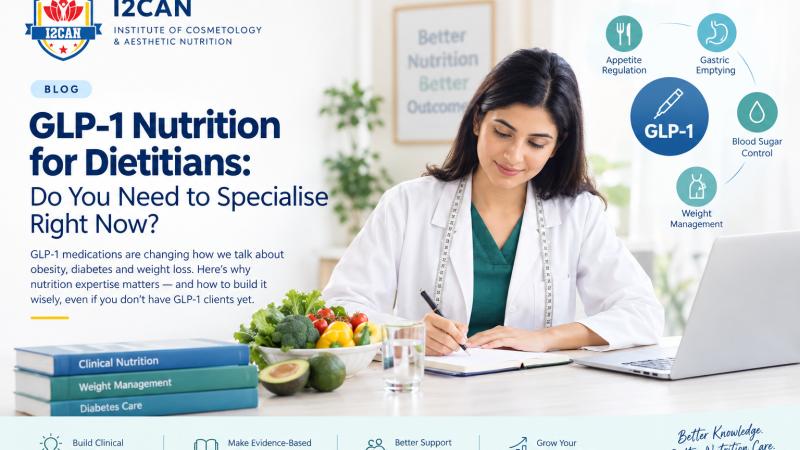
GLP-1 medications are changing how we talk about obesity, diabetes and weight loss. For dietitians and nutrition students, that raises a practical question: should you specialise in GLP-1 nutrition now, or can it wait? You don’t need to become a specialist overnight, but a working foundation is increasingly valuable. Here is why, and how to build one wisely.
Why GLP-1 Nutrition Matters for Dietitians
GLP-1 receptor agonists are medicines that influence appetite, gastric emptying and blood sugar regulation. The prescription is only part of the story. Once appetite drops, nutrition questions follow:
- Is the client still meeting their protein requirements?
- What is happening to muscle (lean) mass during weight loss?
- Are micronutrient needs being met on a much smaller intake?
- How can nausea, constipation and early fullness be managed?
These are nutrition questions, not just medication questions. They call for a dietitian who understands the clinical picture, not one who hands over a standard calorie-deficit plan.
Do You Need GLP-1 Clients Before You Start Learning?
No. Many dietitians work in general clinical nutrition or are building a private practice, with clients who come for weight management, PCOS or diabetes. You may not have met a client on GLP-1 therapy yet.
Still, it is easier to build your understanding before that first client arrives than to learn under pressure. Learning ahead of demand is not the same as chasing a trend. You don’t need to market yourself as an expert or overhaul your practice. You need to understand the science, the nutritional risks, and the situations that call for collaboration with the prescribing doctor.
Is an Advanced GLP-1 Course Worth the Investment?
Not every interesting topic needs an expensive course. Research papers, clinical guidelines and webinars teach a great deal. Before enrolling in anything, ask three questions.
Will it sharpen your clinical reasoning?
Can you assess protein adequacy, spot nutritional risks, and understand how reduced appetite changes what a client actually eats?
Will it improve your decisions?
You should be able to tell apart what needs nutrition counselling, what needs monitoring, and what needs referral to the prescribing clinician.
Does the format justify the cost?
Information you can find free elsewhere isn’t worth paying for. Structured clinical teaching, case-based application, practical frameworks and feedback on your decision-making are. If the only reason to enrol is that GLP-1 is trending, it may be better to wait.
How to Start Learning GLP-1 Nutrition Step by Step
If a course feels like too big a commitment right now, begin with the fundamentals:
- Learn the physiology. Understand how GLP-1 medicines affect appetite, gastric emptying and glycaemic regulation.
- Explore the nutrition evidence. Look at lean-mass preservation, protein intake, hydration, micronutrient adequacy and gastrointestinal symptoms.
- Read critically. Separate established evidence from emerging research, and note the limitations of the available data.
- Know your boundaries. Be clear about where nutrition care ends and medical management begins.
From Theory to Practice
Knowing that a medication reduces appetite is one thing. Assessing a client who is eating very little, struggling with nausea and losing weight rapidly takes a different level of clinical reasoning. Connecting what you read to realistic client scenarios is what builds that skill, and it is where structured, case-based learning can help.
Key Takeaways
GLP-1 therapy raises real nutrition questions that dietitians are well placed to answer.
You can start learning before you have GLP-1 clients, without claiming expertise.
Judge any course by whether it improves your clinical thinking, not by whether the topic is popular.
Build your foundation, follow the evidence, and recognise when you need further training.
If you are ready to build stronger clinical foundations, explore I2CAN’s nutrition programmes, including the Advanced Diploma in Clinical Nutrition & Dietetics, and choose education that helps you think better as a clinician, not just collect another certificate.
FAQs
Do dietitians need to specialise in GLP-1 nutrition?
Not necessarily. A working understanding of the science, the nutritional risks and the limits of your scope is a sensible starting point, with specialisation if your clients need it.
Why does GLP-1 therapy raise nutrition concerns?
Reduced appetite can make it harder to meet protein and micronutrient needs and to preserve lean mass. GI symptoms such as nausea and constipation also affect intake.
Can I learn GLP-1 nutrition without a paid course?
Yes. Research papers, credible clinical guidelines, webinars and professional discussions are a good start. A course adds the most value when it offers case-based practice and feedback.
What should a dietitian do when a client’s GLP-1 side effects worsen?
Provide nutrition counselling within your scope and refer back to the prescribing clinician when medical review is needed. Dietitians do not adjust medication.