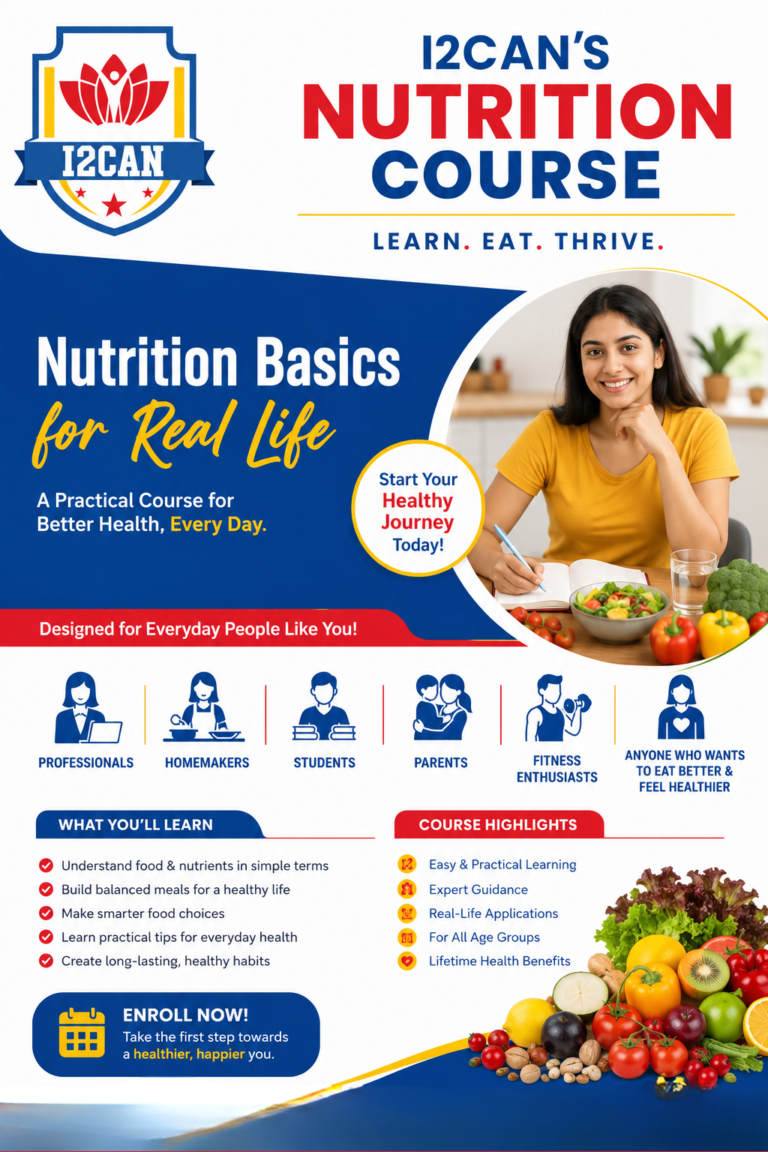
A 13-week nutrition learning program that teaches you how to eat well in real life — with your schedule, your kitchen and your cravings. Live online, every Saturday, taught by I2CAN faculty.
Live online sessions · No prior nutrition knowledge needed · Weekly practice challenges
Practical, not theoretical
Evidence-based teaching
Built for busy schedules
Vegetables 30%
Fruits 20%
Whole grains 25%
Protein & dals 25%
Week 2 · Building your healthy eating plate
Starts
29 Aug 2026Saturday
Duration
13 WeeksOne session a week
Schedule
Every SaturdayWeekend-friendly
Timing
11:00 – 12:3090 minutes, IST
Mode
Live OnlineJoin from anywhere
01 / The case for learning this
Your body is built from what you eat every ordinary day
Not from the detox you did in January. Modern life has quietly rewritten how we eat — longer work hours, packaged convenience food, skipped meals, late dinners, and stress that sends us straight to the snack cupboard. The effects show up slowly: low energy by 4 PM, poor sleep, bloating, frequent illness, stubborn weight.
What changed in one generation
Traditional Indian eating was seasonal, fibre-rich, fermented and home-cooked. Today the average plate carries more refined flour, more sugar, more salt and far less fibre — while portion sizes have grown and physical activity has shrunk.
Your gut feels it first. The trillions of bacteria in your digestive tract feed on fibre and fermented foods; starve them and digestion, immunity and even mood take the hit. Your brain feels it next — blood sugar spikes and crashes are one of the most common reasons for afternoon fog and irritability.
None of this needs a dramatic fix. It needs an education you were never given: how to build a balanced plate, read a food label honestly, shop well, and keep it going on your busiest week.
Where a healthy eating plan actually helps
Energy. Balanced meals with fibre, protein and healthy fats release energy steadily instead of in spikes.
Gut health. Fermented foods, probiotics and prebiotic fibre support a more diverse gut microbiome.
Immunity. Adequate protein, zinc, vitamin C and vitamin D intake support normal immune function.
Focus and sleep. Meal timing, caffeine habits and foods that boost the brain — omega-3s, B vitamins, iron — influence how well you think and rest.
Weight and heart health. Nutrient dense foods for weight loss, portion awareness and a heart healthy eating plan work better together than any single restriction rule.
56%of India's total disease burden is linked to unhealthy diets
74%of deaths worldwide are caused by noncommunicable diseases
101Mpeople in India are living with diabetes
39.5%of Indian adults have abdominal obesity
Sources: ICMR-NIN Dietary Guidelines for Indians (2024) · World Health Organization · ICMR-INDIAB study, The Lancet Diabetes & Endocrinology (2023)
02 / The honest problem
Diets don't fail because you lack discipline
They fail because they were designed for a life nobody actually lives. Six weeks of boiled chicken and salad has never survived a wedding season, a deadline week, or a bad night's sleep. The moment the plan ends, the old habits are still there — untouched, unlearned.
Why the crash diet cycle repeats
✕Extreme restriction triggers stronger cravings, not fewer.
✕It runs on motivation, which is a mood — not a system.
✕Rules replace understanding, so you can't adapt when life changes.
✕Nothing fits your kitchen, your family food, or your work hours.
✕One "cheat" feels like failure, and failure ends the whole plan.
✕There's an end date — and after it, no plan at all.
How Art Of Eating works instead
✓One habit at a time, practised for a full week before the next.
✓Understanding first — so you can decide well at any restaurant or grocery aisle.
✓Your existing food, improved. Roti, rice, dal, dosa and all of it stays.
✓Designed around 60-hour work weeks, travel and family meals.
✓Recovery is part of the method, not proof you failed.
✓13 weeks to build habits that keep working after the course ends.
The short version: Art Of Eating is not a diet plan. It is a nutrition learning program that leaves you with the judgement to plan your own meals — for the rest of your life.
03 / The 13-week curriculum
One idea a week. One habit a week.
Thirteen live sessions, each 90 minutes, each ending with a 7-day action challenge. The order matters — every week builds on the one before it, which is why this works when a weekend workshop doesn't.
01
Session 1 · Saturday, 29 August 2026
How to Create a Strong Nutrition Foundation for Lifelong Health
Carbohydrates, protein, fats, vitamins and minerals in plain language — and how to assemble a balanced healthy eating plate from whatever is already in your kitchen.
02
Session 2 · Saturday, 5 September 2026
Exercise Made Practical: Building a Routine You Can Actually Maintain
Movement that survives a working week. How activity and nutrition support each other, and how to build a routine you don't abandon by the third Monday.
03
Session 3 · Saturday, 12 September 2026
Smart Grocery Shopping: Choosing Foods That Support Long-Term Health
A ten-second method for reading any food label — added sugar under a dozen names, sodium, and the marketing words that mean nothing. Then we build your weekly list.
04
Session 4 · Saturday, 19 September 2026
How Cooking Methods Can Influence the Nutritional Value of Food
Which oils suit which heat, what boiling, steaming, roasting and deep frying do to nutrients, and the small changes that protect the food value of everyday Indian cooking.
05
Session 5 · Saturday, 26 September 2026
How to Maintain Good Gut Health
What the gut microbiome does, and why fibre and fermented foods matter more than any supplement. Curd, kanji, idli batter and other foods good for gut health you can start this week.
The biology of a craving and the habit loop behind it. How to tell hunger, appetite, boredom and stress apart — and give each one a different answer.
07
Session 7 · Saturday, 10 October 2026
Supporting Better Sleep and Stress Management Through Nutrition & Lifestyle Habits
Caffeine timing, evening meals and blood sugar swings. How what you eat shapes how well you sleep, think and recover — including foods that boost the brain.
08
Session 8 · Saturday, 17 October 2026
Making Sense of Supplements: What to Consider and When
Food first, supplements second. When they genuinely help, how to read a supplement label, and which questions to take to your doctor before you spend anything.
09
Session 9 · Saturday, 24 October 2026
Dietary Approaches to Strengthen the Body's Immune System
Protein, zinc, vitamin C, vitamin D and sleep — what the evidence actually supports for normal immune function, and what it doesn't.
10
Session 10 · Saturday, 31 October 2026
Sustainable Weight Management: Building Habits That Support Long-Term Success
Energy balance explained honestly. Nutrient dense foods for weight loss, portion awareness without weighing scales, and why fruits and vegetables for weight loss beat any supplement.
11
Session 11 · Saturday, 7 November 2026
Nutrition Strategies to Support Healthy Blood Sugar Balance
Whole grains, meal sequencing and food rich in fibre for weight loss and steadier energy. How to build meals that don't spike and crash through the afternoon.
Practical, kitchen-based approaches using everyday foods — iron, fibre, protein and blood sugar balance — to support hormonal wellness alongside your doctor's guidance.
13
Session 13 · Saturday, 21 November 2026
Nutrition for Healthy Skin & Hair Health
Protein, iron, omega-3s and hydration, plus an honest look at what nutrition can and cannot do for skin and hair.
After every session
A 7-day practice challenge to apply what you've just learned — plus WhatsApp support from your speaker and the cohort community while you do it.
One fee. Ten things you keep — including the resources, the community and two months of dietitian support.
13 Live SessionsNinety minutes each, taught live with time for your questions.
Session HandoutsA printable summary sheet after every week's class.
Learning ResourcesRecipe frameworks, food lists, swap charts and reading guides.
Instagram BadgeA shareable achievement badge for the day you finish.
Weekly ChallengesThirteen 7-day action challenges that turn learning into habit.
SpeakersSessions led by clinical and nutrition practitioners.
WhatsApp CommunityA private cohort group for questions, wins and accountability.
Practical ToolsPlate guides, grocery templates, label checklists and planners.
Habit FrameworksThe habit-building system that keeps this going after week 13.
Included with the full course2 Months Dietitian SupportComplimentary nutrition support from one of our trusted dietitians.
05 / Who this is for
Built for people with busy lives, not perfect ones
If you've read the nutrition advice and still don't know what to cook on Tuesday, this eating habits course was designed for you.
Busy professionals
Corporate employees
Working adults
Homemakers
Complete beginners
Fitness enthusiasts
Anyone stuck in unhealthy eating patterns
People who struggle with cravings
People with inconsistent eating habits
Adults planning for long-term wellness
Parents feeding a family
Anyone tired of starting over
Who it isn't for: anyone looking for a personalised medical diet, a rapid weight-loss plan, or treatment for a diagnosed condition. This is a nutrition education program, not clinical care — if you have a medical condition, keep working with your doctor or dietitian and use this course to understand their advice better.
06 / Myths & facts
Fifteen things you were probably told wrong
Tap any card to see whether it's a myth or a fact — and why. This is the kind of clarity every session in the course is built on.
Educational content only. Not a substitute for individual medical or dietetic advice.
What's your NQ — Nutrition Quotient?
NQ is a free 15-question test that measures how much you really know about everyday healthy eating — balanced plates, food labels, cooking methods, gut health, cravings and more.
It takes 5 minutes. At the end, you get:
Your NQ score and your band — Explorer, Aware, Informed or Food Wise
A personalised report showing exactly where your knowledge is strong and where the gaps are
A shareable badge for your Instagram or WhatsApp
A discount of up to 20% on The Art of Eating course, based on your score
Most people score lower than they expect. A few score higher. Either way — you’ll know exactly where you stand.
No. There is no certificate. Each session has a 7-day challenge; completing it earns a shareable achievement badge.
Can I become a nutritionist/dietitian after this?
No. This is for general-public nutrition education. It is not a professional qualification and does not qualify you to practise.
Can I practise or make diet plans for clients after this?
No. The course is not a licence to practise or prescribe diets professionally
Who can join?
Any general-public adult interested in learning practical healthy eating. There is no strict educational eligibility
I have diabetes / PCOS / thyroid / hypertension. Can I join?
Yes, for general nutrition education. The course does not replace personalised medical or dietetic treatment
Is this a weight-loss course?
No. Sustainable weight management is one topic, but the program focuses on long-term healthy eating and lifestyle habits. No specific weight-loss result is promised
Will I get a personalised diet plan?
Not as part of the 13 weekly teaching sessions. Full-course participants receive 2 months complimentary dietitian support after completion, including 2 consultations and a diet plan
What if I miss a session? Will I get a recording?
No. Sessions are live and recordings are not provided
Can I take only one session?
Yes. Individual sessions are ₹1,800 each and include that live session plus its 7-day challenge
If I buy many individual sessions, do I get the 2-month support?
No. That bonus is ONLY for people enrolled in the complete ₹12,000 program
Can I attend future batches again after paying once?
No. Repeat access to future batches does not apply to The Art of Eating
Is there a refund / cancellation / transfer / postponement?
No. These are not applicable
Why join if nutrition information is already available online?
Because the focus is practical application. The program teaches how to make healthy eating work during real-life situations – busy workdays, grocery shopping, cooking, cravings, social events, travel, sleep, stress and changing routines
I already know what healthy eating is. Why do I need this?
Knowing and consistently doing are different. This program focuses on turning nutrition knowledge into realistic habits you can actually maintain
₹12,000 feels expensive. What do I get?
The complete enrolment covers all 13 live sessions, learning resources and 13 practical challenges, plus 2 months complimentary dietitian support after completion with 2 consultations and a diet plan
Get Course Details
Share your details and an I2CAN expert will call you to pick the right course. No pressure, No spam.