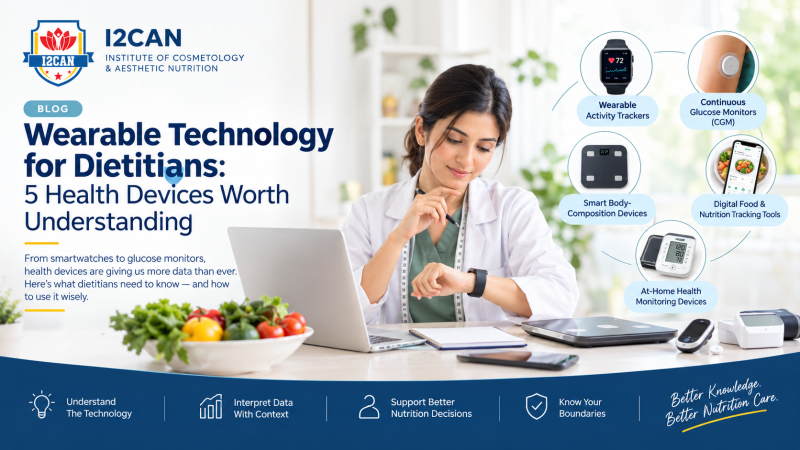
A client walks into your consultation wearing a smartwatch. Another tracks glucose with a sensor on their arm. A third uses a smart scale that estimates body composition. Each device produces a different kind of information, and the question for nutrition professionals is how much of it we actually use, and how well we interpret it. This guide explains five categories of health technology that dietitians are increasingly likely to encounter.
Why Health Technology Matters in Nutrition Practice
Technology in nutrition is no longer limited to calorie-counting apps. A growing ecosystem of devices now lets us observe aspects of health that were once hard to track outside a clinic. A consultation may soon involve more than a food recall, a weight history and a lab report. That brings opportunity, but also a responsibility: knowing which data are meaningful, which are only estimates, and which should not influence a nutrition decision at all.
Five Types of Health Technology Every Dietitian Should Know
Wearable Activity Trackers
Smartwatches, fitness bands and smart rings track physical activity, step counts, heart rate and estimated energy expenditure. Many also report sleep duration and recovery metrics. These can help explain why a client’s appetite, energy or exercise recovery changes from day to day. The key point is that they provide estimates, not direct measurements of every physiological process.
Continuous Glucose Monitors (CGM)
A CGM uses a small sensor under the skin to measure glucose in interstitial fluid, giving a continuous picture of trends rather than isolated readings. For dietitians working with diabetes, this can inform conversations about meal timing, carbohydrate intake, medication and individual glucose responses, in collaboration with the treating clinician. Context is essential, though. A glucose rise after a meal does not automatically mean the meal is unhealthy.
Smart Body-Composition Devices
Smart scales and bioelectrical impedance analysis (BIA) devices estimate body fat, fat-free mass and sometimes body water. They can complement weight tracking during weight management or body recomposition. However, hydration, recent meals, exercise and measurement conditions all influence the readings, so a change in estimated muscle mass doesn’t necessarily mean muscle tissue has actually changed.
Digital Food and Nutrition Tracking Tools
Food-logging apps, photo-based meal trackers and connected dietary platforms help record meals, estimate nutrient intake and reveal eating patterns. Some use AI to recognise food from photographs, but portion sizes, ingredients, cooking oils and mixed dishes are hard to estimate accurately. For a dietitian, the real value lies in spotting recurring patterns rather than treating every calorie figure as exact.
At-Home Health Monitoring Devices
Home blood-pressure monitors, connected thermometers and selected clinically validated testing devices can provide useful readings outside the clinic. Depending on the context, they may support conversations about cardiometabolic health and whether further assessment is needed. They do not replace laboratory testing, clinical examination or medical diagnosis.
How Dietitians Can Use Device Data Responsibly
Three habits make device data useful rather than misleading. First, separate measurement from estimate: most consumer devices infer values rather than measure them directly, so treat a single reading with caution and look for trends over time. Second, always add context. Sleep, hydration, stress, meal composition and the timing of a measurement can all change a number without changing a client’s actual health. Third, know your boundaries. When data points to something that needs medical attention, or involves medication, involve the treating clinician instead of acting on a gadget’s output alone.
A wearable might flag poor sleep, a CGM might reveal a glucose pattern, and a smart scale might suggest a change in body composition. The device supplies the information. Clinical reasoning decides what to do with it.
Conclusion: Interpretation Matters More Than Collection
As more health data becomes available to clients, a dietitian’s advantage is unlikely to come from collecting more of it. It will come from interpreting the right data, in the right context, for the right person. Building that skill rests on strong clinical foundations in nutrition science, assessment and counselling. If you are ready to strengthen yours, explore I2CAN’s Advanced Diploma in Clinical Nutrition & Dietetics.
A wearable might flag poor sleep, a CGM might reveal a glucose pattern, and a smart scale might suggest a change in body composition. The device supplies the information. Clinical reasoning decides what to do with it.
FAQs
How can dietitians use wearable data in practice?
They can use it to spot patterns in activity, sleep and recovery that may explain changes in appetite or energy, while remembering that wearables give estimates rather than direct measurements.
Does a glucose spike after a meal mean the food is unhealthy?
Not automatically. Context matters, and CGM data is best interpreted alongside the client’s overall picture and in collaboration with the treating clinician.
Are smart scales accurate for muscle mass?
They give estimates that are influenced by hydration, recent meals, exercise and measurement conditions, so a shift in estimated muscle mass doesn’t necessarily mean real muscle change.
Are calorie-tracking apps reliable?
They are most useful for revealing eating patterns. Portion sizes, cooking oils and mixed dishes are hard to estimate, so the numbers shouldn’t be treated as exact.
Can home health devices replace lab tests?
No. Consumer devices can support conversations about health, but they don’t replace laboratory testing, clinical examination or diagnosis.